Research
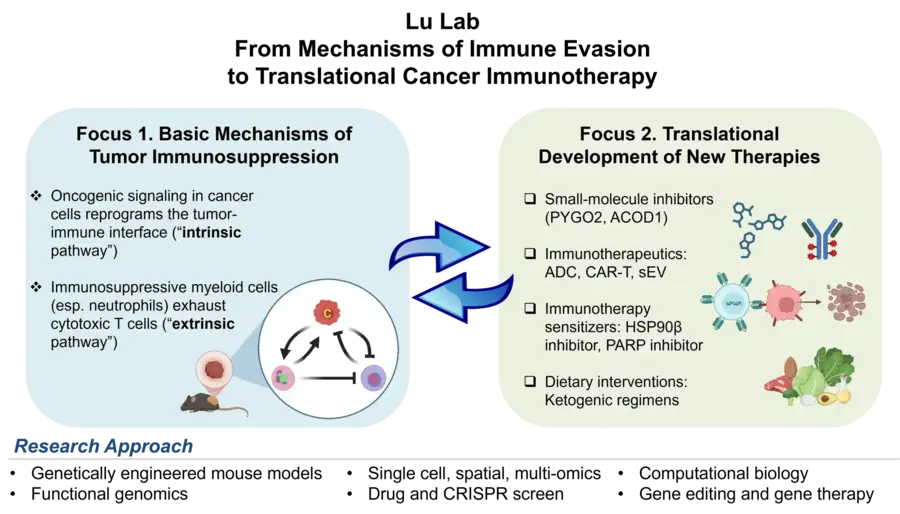
The Lu Laboratory at the University of Notre Dame integrates mechanistic tumor immunology with translational drug discovery to decode immune evasion, metastasis, and therapy resistance in solid tumors. Our research program characterizes the complex crosstalk between neoplastic cells and the immunosuppressive tumor microenvironment (TME) to develop next-generation combination therapies. We aim to convert “cold” tumors into “hot,” therapy‑responsive lesions by dissecting and targeting the crosstalk between cancer cells and the immune/stromal compartments.
· Cancer Cell-Intrinsic Programs: We investigate how genetic and epigenetic alterations construct "cold" tumor microenvironments. We identified the chromatin effector Pygo2 as a major driver of T-cell exclusion and prostate cancer metastasis (Science Immunology, 2023), and we are currently developing first-in-class small-molecule inhibitors to reverse this resistance.
· Myeloid Immunometabolism: We study how tumor-infiltrating neutrophils and myeloid-derived suppressor cells (PMN-MDSCs) drive immunotherapy failure. We discovered that neutrophils escape ferroptosis in metastatic niches via an Acod1-dependent immunometabolic switch (Cell Metabolism, 2023). Eliminating Acod1 or deploying our established myeloid-targeting regimens (e.g., SX-682, cabozantinib) powerfully sensitizes refractory malignancies to immune checkpoint blockade (Nature, 2017).
· Next-Generation & Host-Level Therapeutics: Our therapeutic pipelines include Antibody-Drug Conjugates (ADCs), CAR-T cells, and host-level metabolic interventions—such as cyclic ketogenic regimens that systematically reprogram the TME to overcome anti-PD-1 resistance (Cancer Research, 2024; Cancer Letters, 2026).
· Advanced Experimental Toolbox: We combine specialized genetically engineered mouse models (GEMMs) with advanced cell/organoid/bioengineered systems, high-throughput CRISPR screens, single-cell RNA-seq, spatial transcriptomics, and computational digital pathology (Cancer Communications, 2024) to map the cancer ecosystem with high dimensionality.
· Scope & Funding: Supported by robust funding from the NIH/NCI, DoD, foundations and private sectors, our translational research spans prevalent malignancies (breast, prostate, pancreatic, kidney, bladder) and rare diseases (penile cancer, Von Hippel-Lindau disease). We actively partner with clinical oncology networks to accelerate bench-to-bedside translation and welcome passionate graduate students, postdocs, and undergraduates eager to transform cancer medicine.
